



Description
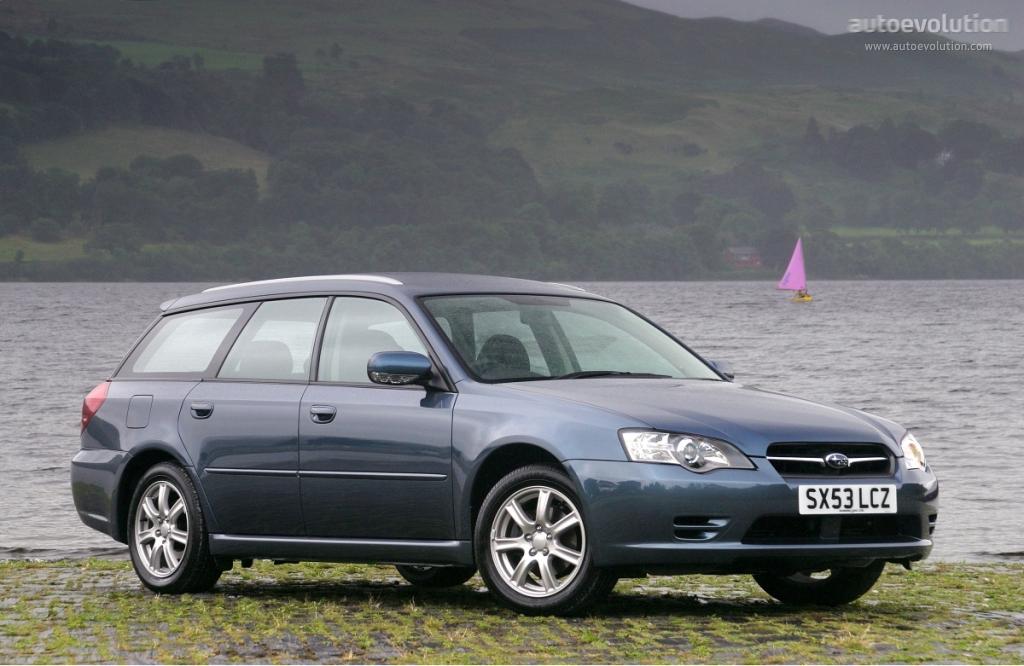
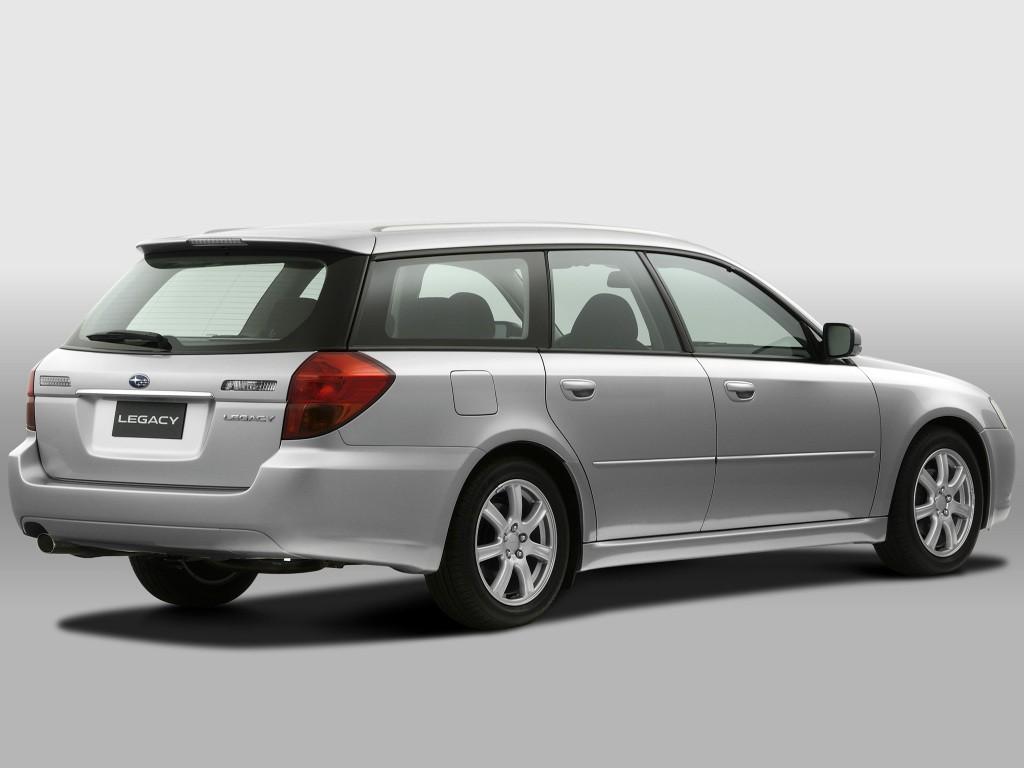
Subaru introduced the fourth generation of the Legacy in 2003 and offered it in two body-shapes: a sedan and a station wagon, and both shared the same platform with the Tribeca SUV.
While its Impreza lineup was the car that decorated dorm-rooms and smashed rally stages all over the world, the Legacy was designed as a family sedan, but without forgetting about its racing achievements. In the station wagon shape, the Legacy looked more committed to providing everything a family needed in terms of cars.
Before the 2003 Legacy, there were just a few who liked Subaru's design. The Japanese carmaker looked like it paid high-money for the engineers and lunch-money for its designers. But the 2003 Legacy was different. It still kept the frameless doors, but it added an inspired front fascia with sharp, curved headlights. The grille sported the winged badge, while the front bumper featured a wide center air intake and four side vents. In the rear, Subaru made a raked-forward tailgate with a roof-spoiler on top of it, while the wide and low opening in the bumper allowed an easier loading and unloading from the trunk.
Inside, the low seating position reminded its occupants that they are in a Subaru, not into some kind of old-fashioned box on wheels. The front bucket-seats provided, depending on the version, high-bolstering. The carmaker installed a split-folding bench for up to three passengers in the rear, but with less room for the middle one since there was a transmission tunnel that crossed the station wagon from front to back.
Under the hood, Subaru installed its famous symmetrical all-wheel-drive system connected to a choice of five boxer engines ranged between 138 hp and 260 hp, depending on the market.
Press Release
The Subaru Legacy is a mid-size car introduced by the Japanese manufacturer Subaru in February 1989 as a larger, more upscale companion to the Subaru Leone/Loyale. It came with a 2.0 L engine and was available with all-wheel drive, which later became standard worldwide. In Australia, where it is sold as the Subaru Liberty (due to Australia's Legacy organisation rejecting the use of their name), it was Wheels magazine's Car of the Year for 1994 and again for 1998. Upon the Turbo's introduction to the Australian market it was claimed to be the fastest accelerating car for under $100,000 on the Australian car market.
In North America, the Legacy was introduced in 1990, with a 2.2 L engine driving front and all-wheel drive powertrains as options. Both sedan and wagon models were available. In 1991, a turbocharged sedan model became available, though its engine differed somewhat from that of other market offerings. A turbocharged wagon debuted in 1992 as a special edition. All turbo models in North America ceased production with the introduction of the second generation Legacy, starting in 1995. The North American Outback model, with the help of clever marketing, halted declining sales and was instrumental in attracting investment interest from General Motors. GT models, first offered as a wagon trim package in 1994, became a full-blown upgrade in 1996, using the new DOHC 2.5 L engine. GT models continue to the present model, with Limited editions available, offering leather trim and a sunroof. The North American market launch of the 2005 model brought back the turbocharged Legacy to the region, much to the delight of the model's fans.
In the Pacific Northwest, the Rocky Mountain region and New England, the Legacy has gained considerable popularity as an icon of the outdoor lifestyle. The Legacy (and the Outback especially) typifies the outdoor lifestyle market in the US; this is an image of Subaru that differs greatly from that which the rest of the world has of it. The rise of the performance-oriented Impreza has done much to change the brand image in recent years, emphasizing performance and safety as well as utility.
In Japan, the Legacy has a reputation for being an affordable, quick, and nimble car. Subaru is trying to follow the success of the Impreza worldwide with the Legacy, offering turbocharged models in Japan and the Americas. The latest Legacy model has never had a turbocharged version released in Europe due to emission problems.
On April 23, 1998, a Subaru Legacy set a new world speed record for mass-produced turbocharged station wagons (1600 cc-2000 cc class), clocking 270.532 km/h over one kilometer on Highway 10 in La Junta, Colorado. This record was previously set by a Generation II Subaru Legacy in 1993 at 249.981 km/h.
The original Legacy speed record was set between January 2nd and 21st, 1989, with a Japanese-spec RS sedan at the Arizona Test Center outside of Phoenix, Arizona. It broke the 100,000 km FIA World Land Endurance Record by maintaining an average speed of 138.780 mph (223.345 km/h) for 447 hours, 44 minutes and 9.887 seconds, or 18 1/2 days. Pit stops were made every two hours with a driver change and refueling, while tire changes were made at 96 hour intervals, or every 13,400 miles driven.
On March 14, 2005, Subaru sold its three-millionth Legacy worldwide.
Engines
The EJ-series engine was introduced first in the Legacy. It offers many important improvements over the previous engines, such as five main bearings instead of three. All Legacy engines are horizontally-opposed flat engines with at least one overhead cam per side. The great thing about the EJ series is its versatility - any EJ style engine will fit any subaru made between 1990 and 2006.
1.6 L & 1.8 L world-market four-cylinder engines exist. Some are likely to be carbureted, or feature a single central fuel injector.
2.0 L & 2.2 L fours were available in normally aspirated, fuel injected form in most markets. This is the most commonly used legacy engine. The 2.0L quad cam 16v version produces 123kW of power.
2.0 L turbocharged and intercooled fours have been a staple of the Legacy in world markets. Single and twin turbo models existed only in world markets, never available in North America. Twin turbos were used until 2003 when a single twin-scroll titanium turbocharger sourced from IHI and Mitsubishi- for automatic transmission models (and very similar to that used in the Mitsubishi Lancer Evo VII onwards) was adopted by Subaru.
2.2 L turbocharged four-cylinder engines were available in the North American Legacy between 1991 and 1994. This was a unique version not equipped with an intercooler while featuring a single overhead camshaft. It has many resemblances to the RA-version engines in world markets.
2.5 L, DOHC, normally aspirated and fuel injected four-cylinder engines were available in the US market beginning in 1996. A revised version, with a single overhead camshaft, was available in North American models beginning in 2000. Some hybrid versions have been known to exist in Outback models during the 1998-99 years. World markets received versions of this engine with variable valve timing as early as 2001.
2.5 L, DOHC, turbocharged and intercooled four-cylinder engines are available in North American market GT models, beginning in 2005. This engine shares many parts with other versions of the Impreza WRX STi, Forester XT and Baja Turbo, as well as the Outback XT which are available only in the North American market.
3.0 L, DOHC, normally-aspirated flat-6s became available in the Japanese market in 2000 and the North American market in 2001. This was a complete redesign, and shares only peripheral parts with earlier flat- or boxer-six engines. This engine is optionally available in the North American market Outback. An updated 3.0 L six, known as the EZ30R, features variable valve timing called AVCS. This version entered the North American market with the introduction of the 2005 Outback.
Performance models
Subaru has produced high performance versions of the Legacy with a Bilstein suspension and tuned turbocharged engines equivalent to the homologized rally version WRX STI (generating 205 kW on manufacturer's figures for the 2.0 L equivalent engine with manual transmission). Recent 3.0 L engines move close to the 2.0 L turbo output and share the Bilstein suspension. 2.0 L-engined turbocharged models with the Bilstein suspension were named either the GT-B (for wagons), or Spec B, or RSK-B4 (for sedans). The new 2003 model moved many models to simply B4 or even GT in some countries. The Spec B badge still exists in the UK, where the 3.0R stands as the premier MY06 model.
In North America, early sporty models were known simply as the Sport Sedan and Touring Wagon. Later models were given the GT and GT Limited nomenclature. The 2006 Legacy model brought forth a limited run of 500 Spec B models. This model features an improved suspension, navigation, larger wheels, and other driving and aerodynamic improvements over the GT model.
The new 2007 Legacy Spec B will be mass produced, unlike the limited production of 500 units from the '06 model within the US.